
The agency has named 247 people as accused in the case, according to NIA sources.
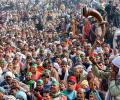
Tens of thousands of farmers gathered in Muzaffarnagar town on Friday to attend a mahapanchayat in support of the Bharatiya Kisan Union-led protest against the Centre's new farm laws in Ghazipur on the Delhi-Uttar Pradesh border.

The kisan is as integral a part of the BJP's master plan for the 2019 polls as the Dalit because it surmised that the farmers and Dalits were as restive in UP as in much of the country, and if it had to cut its losses, its reflexes must kick in fast. Radhika Ramaseshan reports.

'If Pinarayi Vijayan gets another term, Kerala will be a state where everybody has a house.'

'Both Modi and Yogi are contesting this election together.' 'Both bring their individual strengths to BJP in UP.'
'It doesn't help to transpose the Hindi heartland model on Bengal. Bengalis don't understand its dynamics. They won't comprehend the impact of Modi's dip in the Ganga because Bengal's political culture is different. Even in the Ramakrishna Mission Ashrams, Christ is worshipped on Christmas. It's difficult to polarise Bengal religiously'
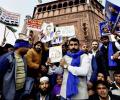
Out on bail, the Bhim Army chief said 'it will be shameful if I don't call him out for saying that those indulging in violence can be identified by their clothes itself'.

'It is more of a catalyst.' 'People bring in their own demons and they are not created by fake news'

'The police are busy arresting people from Delhi, but not those we saw burning our home!'

'It did not start as a Hindutva slogan.' 'It started to tease the TMC and slowly it got internalised and the BJP started countering with Jai Shri Ram slogans because Mamata was getting provoked.'
The core BSP campaign continues to be 'cadre-based' and personal connect, such as knocking each door or through nukkad sabhas.

'Muslims may turn to the BJP or may not come out to vote in great numbers like they have in the past.' 'Anything can happen.' 'They can feel an increased sense of alienation, but that depends on the BJP -- on how it includes them.'
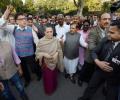
Why are the 'secular' parties silent about the lynchings on our streets? Are they so busy forging political alliances that they ignore the numerous distortions of Constitutional values?

Addressing AAP's first rally in the state, Kejriwal said BJP and Congress were like "husband and wife" and alleged that Prime Minister Narendra Modi and Congress leader Ahmed Patel work "in unison".

'There are some castes that grab power, then pass on the benefits to those who belong to their own caste.'
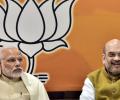
Amit Shah's meticulous planning and Modi's charisma will turn the tide in the BJP's favour, says Nazarwala.
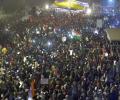
'This is millions of Indians standing up for values rather than an individual gain.' 'This is why this protest is unique and this is why this protest has for the first time made this government uncertain and doubtful of what to do next,' says Aakar Patel.

'Even if the government does not implement an all-India NRC before 2024, it will be part of the party's long-term project.'
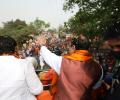
'They are our go-to men, our trouble-shooters.' 'They draw their strength from remaining low-key and accessible only to our workers.'
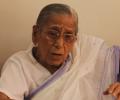
Sunder Navalkar devoted her whole life to the cause of workers' rights, remembers Sanober Keashwaar.
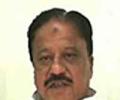
Banks on mobilising support from Dalit and Muslim voters. Sanjay Jog reports.

'The sadhus and sanyasis of UP are not for any economics.' 'They only know the religious agenda and the RSS will support them.' 'Modi does not have full control of the party at the ground level like Indira Gandhi had.'

Mohammad Sajjad raises important questions about the response to lynchings.
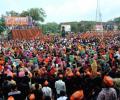
The state government is worried that the agitation may pose a serious threat to it, reports Sanjay Jog.
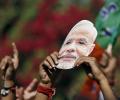
In Bundelkhand, support for Narendra Modi seems to cut across the caste barriers; even so, a vigorous and 4-cornered tussle is on the cards. Sahil Makkar reports
Writing on January 18, 2017, Nazarwala had this to say: 'The Modi wave may help the BJP score a triple century; its vanvaas in UP shall end before Holi.'
Writing on January 18, 2017, Nazarwala had this to say: 'The Modi wave may help the BJP score a triple century; its vanvaas in UP shall end before Holi.'
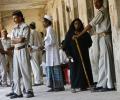
Muslims need to get out of their Isolation Syndrome, argues Mohammad Sajjad.
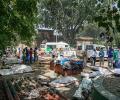
'Every family in UP has been deeply affected in this second wave.' 'It has only been denial, denial, and denial by the incumbent CM.'

'A one party-State, with only one kind of Indian,' argues Mihir S Sharma.
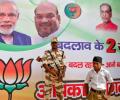
Nearly 1,500 akansha petis (boxes of aspirations) have been placed in colleges for students to reveal what they expect from a BJP government. While demonetisation figured high in villages, BJP strategist Siddharth Sikka says city youth were "more concerned" about law and order and sanitation.

'Nitish is now a helpless junior ally of Hindutva.' 'He just cannot think of reining in the hoodlums raging, marauding and killing in the mohallas,' argues Mohammad Sajjad.

Rao was taken into custody in Hyderabad on Saturday after his house arrest ended on November 15 and his petition to quash the transit remand was disposed of by a court there on November 16.
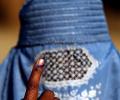
'Compared to other social groups, managing the Muslim constituency has always been easier for the secularists.' 'Just some symbolic measures and window-dressing would keep the Muslim flock together.' 'Having been betrayed by all the supposedly 'secular' political parties, Muslims should turn into citizens without any ascriptive identity marks,'says Mohammad Sajjad.

M I Khan in Patna Nearly twelve years after he left the National Democratic Alliance and resigned from the Atal Bihari Vajpayee government after the Gujarat riots in 2002, Lok Janshakti Party chief Ram Vilas Paswan will share the dais with Gujarat Chief Minister and Bharatiya Janata party's prime ministerial candidate Narendra Modi at his 'hunkar' rally in Bihar's Muzaffarpur town on Monday. Paswan, who joined the NDA last week to contest the Lok Sabha polls and took a U-turn on Modi, will appear in public with the BJP's top brass including Modi at the rally. Paswan's son Chirag will also be present at the function. Upendra Kushwaha is another new face that will be at the event. Kushwaha is the chief of the Rashtriya Lok Samata Party (RLSP) that joined hands with the BJP last week. Both Paswan and Kushwaha are known as their own caste. Paswan is said to enjoy overwhelming support of his caste -- locally known as Dusadh, the only Dalit caste in Bihar after Chief Minister Nitish Kumar categorised 21 other Dalit castes as 'Mahadalit' -- poorest of the poor. Kushwaha has been trying hard for last few years to emerge as a leader of his caste -- Koeri, an agrarian backward caste spread across the state. A senior BJP leader said that presence of Paswan and Kushwaha will send a strong political massage among respective castes in Bihar. "It will strengthen the BJP's social support base in Bihar," he said. In Bihar, the BJP is widely seen as an upper caste party. The much-hyped rally is seen as a bid to mobilise support and strengthen the support base in the state. The state in the Hindi heartland that sends 40 Lok Sabha members to Parliament is politically very important. In the 2009 Lok Sabha polls, the party had won 12 seats, while the Janata Dal-United won 20 seats, when they had contested as a combined force. It is expected that Modi will target Kumar, who has openly opposed him by repeatedly saying that the prime ministerial candidate should be of nsecular credentials.

India's Muslims need to assert their educational and economic upliftment and political empowerment rather than be provoked by communal remarks, says Mohammad Sajjad, reflecting on the Malda riot.

From carrying portraits of their sons and husbands who have committed suicide due to agrarian distress to picketing to doing sewa 24x7 at langars, women have shown a rare determination not to capitulate before the government.
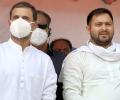
Will the M (Muslims) in the RJD's M+Y move fast swiftly towards the MIM and away from the RJD, asks Mohammad Sajjad.

Dr Kaushal Kishore Mishra, the prime accused in the assault case against Somnath Bharti, says he never attacked the AAP leader. He then explains the polarisation politics of Varanasi.
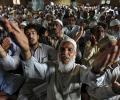
'The Ulema have come out as villains against Indian secularism, impeding the secular united resistance against violent Hindutva that is backed by ministers in the government,' says Mohammad Sajjad.
